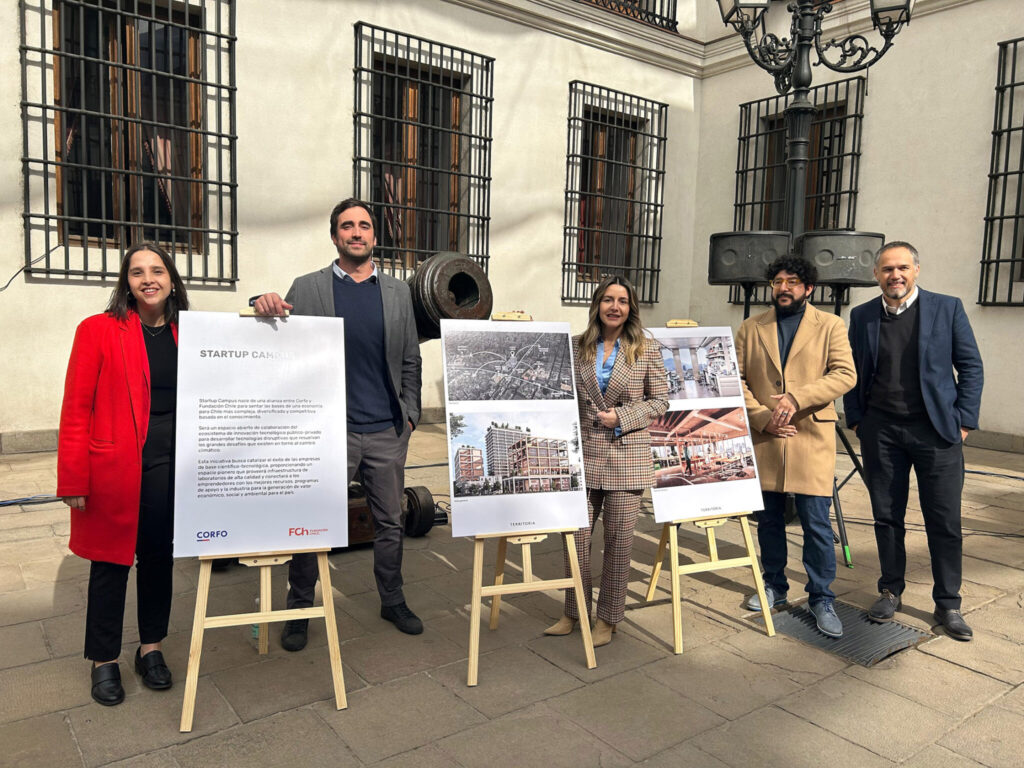
Startup Campus, a project driven by CORFO and Fundación Chile, will be a physical space for collaboration between the public and private sectors, catalyzing the success of startups that leverage science and technology as an engine for innovation and development, and articulating the support available for dynamic entrepreneurship in Chile.
In its first five years of operation, it will support 200 high-potential growth startups, who will have access to highly complex infrastructure such as advanced laboratories and equipment; support programs for the different stages of the entrepreneur’s life cycle; and connection with potential investors and corporate clients, among others.
Startup Campus will have a strategic location in downtown Santiago in a mixed-use project developed by Territoria, which plans to maintain and remodel the former Enel Tower (Santa Rosa 76).
Fourteen years after the creation of the world’s first public accelerator, Start-Up Chile, part of a state public policy to improve the country’s productivity and competitiveness by stimulating innovation and supporting business development, the President of the Republic, Gabriel Boric, announced this Tuesday at La Moneda the creation of a scientific-technological entrepreneurship hub in the country with an investment of 11 million dollars.
The “Startup Campus” project, driven by CORFO and Fundación Chile, aims to be a flagship government initiative to strengthen the entrepreneurship ecosystem, develop applied research in productive and strategic sectors for the country, with a clear focus on contributing to the missions of Just Decarbonization, Resilience and Adaptation to Climate Change, and Sustainable Productive Diversification.
It is a physical space for collaboration between the public and private sectors that will catalyze the success of startups that use science and technology as an engine for innovation and development, articulating the support available for dynamic entrepreneurship in Chile.
For José Miguel Benavente, executive vice president of CORFO, “Startup Campus is part of the process of an evolving public policy to support entrepreneurship that began many years ago. What we are launching today is a tremendously important milestone where entrepreneurs who require laboratories and infrastructure to develop science and technology-based projects, oriented towards clean technologies in all their dimensions, will be able to physically meet. For us, this agreement we have reached with Fundación Chile to move this initiative forward is a source of pride. We hope it will be exemplary and attractive not only for ventures in Santiago but also from other regions and at a Latin American level,” he stated.

In its first five years, “Startup Campus” will support 200 high-potential growth startups, contributing to the validation and development of their technologies, the incorporation of advanced human capital, increased sales, and the search for funding. The impact on the ecosystem will be even greater with a long-term perspective, considering the installation of capabilities that can be replicated and amplified.
This will be an open meeting place for all actors converging in the technological innovation and entrepreneurship ecosystem in Chile and Latam, such as startups, corporations, investors, government, academia, among others, who wish to collaborate in the development of disruptive technologies to solve humanity’s most pressing challenges today.
It is worth noting that CORFO and Fundación Chile conceived and designed this initiative by analyzing and taking into account international experiences and models that have, to date, demonstrated a positive impact on the ecosystems in which they are embedded, such as Boston, New York, San Francisco, Paris, London, Helsinki, Singapore, among others. In its initial phase, various institutions were also convened for a working group to complement knowledge and foster collaboration, including: Endeavor, Banco Estado, Ministry of Science, Technology, Knowledge and Innovation, Hub Apta, Bci, Carey, and The Venture City.
The implementation of this project will position Chile as a benchmark in Latin America and will allow startups to: accelerate their development cycle through access to laboratories and advanced equipment for exclusive use by ventures; robust and complementary support programs for the different stages of the entrepreneur’s life cycle, by articulating existing national and international providers in key areas such as funding, technological validation, commercial traction, internationalization, among others.
Startup Campus will also allow them to foster innovation in an environment conducive to collaboration, experimentation, and iteration; significantly reduce costs by sharing infrastructure; increase the visibility and recognition of startups among potential investors and clients, providing a seal of credibility that facilitates access to private capital and market entry; and finally, promote collaboration between entrepreneurs and corporations, thereby accelerating knowledge transfer and the market entry of new technologies.
Pablo Zamora, executive president of Fundación Chile, said that “we are very pleased to have conditioned the generation of a new public policy related to the creation of an innovation ecosystem based on science and technology to support dynamic ventures. Startup Campus is a very ambitious initiative that we hope will be replicated nationally in different thematic areas and will, in some way, help entrepreneurs who use science and technology to shorten the entrepreneurial journey, build their capabilities, connect them with investors, thus increasing the interaction and growth speed of this type of company.”

Revitalizing Santiago’s Historic Quarter
Startup Campus will have a strategic location in an accessible area with good connectivity in downtown Santiago, in a mixed-use project that plans to maintain and remodel the former Enel Tower (Santa Rosa 76), revitalizing its surroundings and promoting urban development and recovery.
The site selection was carried out through an evaluation process of multiple locations, considering a strategic, technical, and financial analysis. According to the results, the decision was made to incorporate Territoria, an urban project developer, as a project ally, and to install Startup Campus in its Campus Santa Lucía project.
Territoria, widely recognized for its sustainable and city-integrated projects, will provide corporate, commercial, and operational support during the different stages of the Startup Campus implementation process, from its launch to scaling.
The project will occupy a total space of 3,850 m2. Its infrastructure will consist of five types of facilities: co-working, auditorium, private offices, biological sciences laboratory, and hardware, materials, and electronics prototyping laboratory. “Campus Santa Lucía is an innovative mixed-use project that combines spaces for entrepreneurship (co-working, auditoriums, and laboratories), residences, and green areas in downtown Santiago. In line with projects Territoria is developing, such as Mercado Urbano Tobalaba (MUT) and Campus Santander, it adheres to high sustainability standards. This project aims to contribute to the country’s and region’s innovation and entrepreneurship ecosystem, promoting an environment conducive to the development of new ideas and business growth. Startup Campus arrives precisely to be part of and boost this ecosystem,” explained Ignacio Salazar, General Manager of Territoria.